August 2, 2026
Braise a Burmese Pork Curry Until the Oil Comes Back, Then Keep Just a Tablespoon. A 51-Gram-Protein Wet Thar Hin for Tonight.
Subscribe
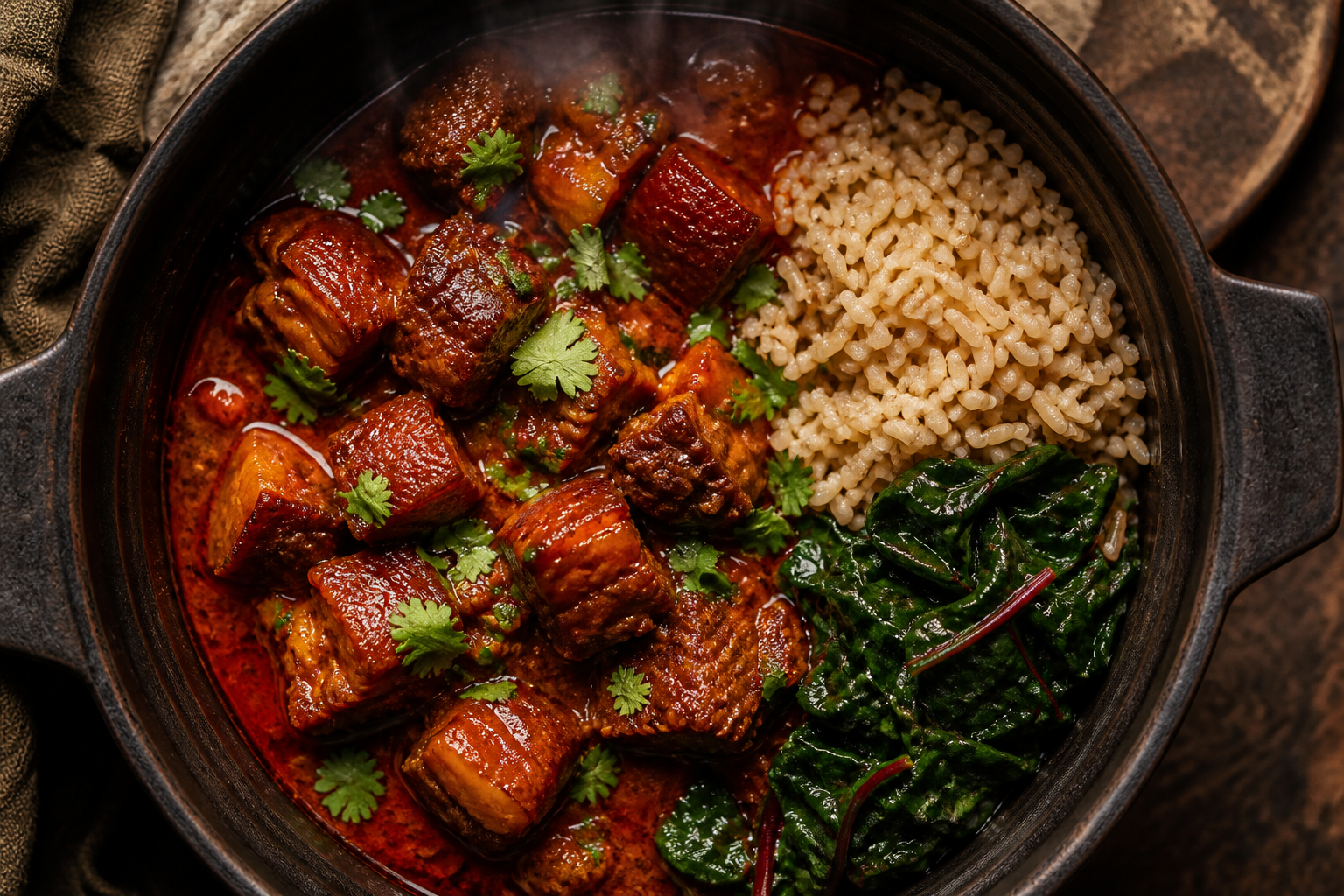
A 30-minute Burmese plate that takes the "oil-returns" curry every Yangon curry house builds in a wide pan and rebuilds it lean: chunks of trimmed pork tenderloin, salt-and-turmeric brined so they stay juicy under a hard two-batch sear that chars the edges, then simmered in a base of onion, garlic, and ginger stained magenta with turmeric, paprika, and chili, bound with ngapi (Myanmar's fermented fish paste, the umami backbone of Burmese cooking recorded in a first-century Mon stone inscription) and soured with tamarind, boiled down until the sauce turns a dark mahogany that lacquers the pork and a thin red oil sheen separates back to the top, set over brown rice with stir-fried Swiss chard, fifty-one grams of protein and about ten grams of fiber for roughly five hundred eighty-five calories, and it eats like a Yangon curry house, not a diet bowl.
A Burmese curry is defined by one moment the cooks call hsibyan, "oil returns." You simmer meat in water and oil until the water boils off and a layer of oil separates and rises back to the surface, and the harsh raw paste of turmeric, garlic, ginger, and fermented fish mellows into something dark and glossy. In a Yangon curry house that top layer is thick, and it is often deliberately topped up with more oil, because the fat seals the pot and keeps the curry safe while it sits open and unheated for hours.
Some restaurants also add extra oil to maintain the correct top layer, as the fat also preserves the underlying food from contamination by insects and airborne bacteria while the curries sit in open, unheated pots for hours at a time.
That, from Austin Bush's field notes on Yangon curry shops, is the tell. The oil pool on a restaurant Burmese curry is partly a preservative, not a flavor. At home you are not feeding a street crowd for six hours, so you do not need a preservative pool. The flavor engine is ngapi, Myanmar's pungent fermented fish or shrimp paste (the earliest extant record is a Mon stone inscription from the first century CE), bloomed with turmeric, garlic, ginger, and tamarind. All of that is essentially calorie-cheap. The calories live in the floating oil and in the fatty cut the tradition demands.
That is where the lean flip comes in. The classic Burmese pork curry, wet thar hin, is a wedding and novitiation-ceremony dish, and the Burmese saying goes "the king of leaves is tea, the king of fruits is mango, and the king of meat is pork." The 196 flavors recipe is blunt about the cut: "absolutely no tenderloins or other lean cuts... you really need that white miracle of globule to make the gravy very indulgent." The old way leans on rendered pork-belly fat for the gravy. The lean way builds the gravy from ngapi, tamarind, tomato, and a hard sear instead, swaps the belly for trimmed tenderloin (a quarter of the calories and a tenth of the fat, with more protein per ounce), and stops the "oil returns" at a thin sheen rather than a pool. The home version MiMi Aye publishes from her mother's Mogok kitchen (in Mandalay: Recipes and Tales from a Burmese Kitchen) uses a manageable four tablespoons of oil for a kilo of pork; the exhibition versions call for three-quarters of a cup of peanut oil plus sesame. A tablespoon is enough if you let the glaze, not the fat, do the work.
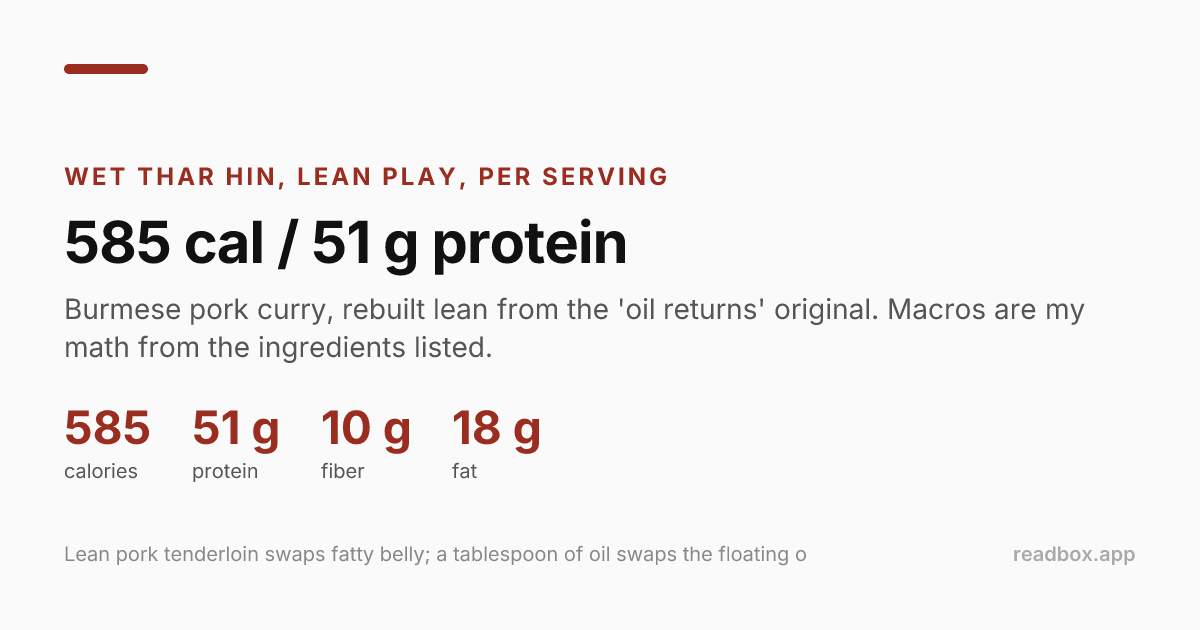
Macros per serving (my math, from the ingredients below)
About 585 calories, 51 g protein, 63 g carbohydrate (10 g fiber), 18 g fat. Serves two. The fat is honest for a curry and low for the genre: pork tenderloin (6.6 g), a tablespoon-plus-teaspoon of oil split between the curry and the greens (9.5 g), and traces from the rice and aromatics. The fiber comes almost entirely from the chard (5.6 g), which is why the greens are not optional here, they are the satiety move.
Ingredients (serves 2)
For the curry:
- 12 oz (340 g) boneless pork tenderloin, silver skin trimmed, cut into 1-inch chunks
- 1 tbsp neutral oil (peanut or canola), for the curry, plus 1 tsp for the greens
- 1 large onion (about 160 g), cut into wedges
- 6 cloves garlic, smashed and roughly chopped
- 1 oz (a 2-inch piece) ginger, grated (or pounded to juice and strained, the Mogok way)
- 1 stalk lemongrass, bruised and tied in a knot
- 1 tsp ground turmeric
- 1 tsp paprika
- 1 tsp chili powder (Burmese or Indian; use half if you are heat-shy)
- 2 tbsp fish sauce (the supermarket stand-in for ngapi)
- 1 tbsp tamarind concentrate (or 1.5 tbsp lime juice)
- 2 tbsp tomato paste
- 2 tsp dark soy sauce
- 2 tsp brown or palm sugar
- 1/2 tsp black pepper, plus more to taste
- Kosher salt
To serve:
- 1 cup brown rice (yields about 2 cups cooked)
- 6 cups chopped Swiss chard (or water spinach, mustard greens, or ong choy), tough stems removed
- 1 clove garlic, smashed, for the greens
Steps (about 30 minutes)
-
Brine the pork. Toss the tenderloin chunks with 1/2 tsp salt and 1/2 tsp of the turmeric. Let them sit 15 minutes while you prep the rest. A short dry brine keeps lean tenderloin juicy under a brutal sear (it goes from perfect to chalky in about a minute, so the brine matters). Skip the traditional 15-minute water simmer MiMi Aye uses to "clean" the pork; for tenderloin it just leaches flavor.
-
Start the rice. Bring 2 cups water to a boil with the brown rice and a pinch of salt, cover, and simmer 25 minutes. Fluff and rest off the heat.
-
Sear the pork in two batches. Heat 1 tsp of the curry oil in a wide pan over high heat until it shimmers. Sear half the pork in one layer, about 2 minutes per side, until charred at the edges but still pink inside. Transfer to a plate. Add another 1/2 tsp oil and repeat with the second batch. Set all the pork aside. Do not wipe the pan; the fond is the start of the gravy.
-
Build the paste. Lower the heat to medium and add the remaining 1.5 tsp curry oil. Add the onion wedges and cook 5 to 7 minutes, scraping up the fond, until soft and beginning to brown at the edges. Add the garlic, ginger, and lemongrass stalk and cook 1 minute. Sprinkle in the turmeric, paprika, and chili powder and stir 30 seconds, until the oil turns a deep magenta-red and smells toasted.
-
Simmer, then glaze. Stir in the tomato paste and cook 1 minute. Return the pork and any juices. Add the fish sauce, tamarind, dark soy, sugar, black pepper, and 1/2 cup water. Bring to a boil, cover, reduce the heat, and simmer 12 to 15 minutes, until the pork is just cooked through (pull it at 145 degrees F and let it rest 3 minutes, the USDA rule for lean pork). Then uncover and boil hard 4 to 6 minutes, stirring, until the sauce reduces to a dark mahogany syrup that lacquers every chunk and a thin red oil sheen separates to the top. That sheen is your hsibyan, "oil returns," done lean. Off the heat, fish out and discard the lemongrass.
-
Wilt the greens. In a second pan, heat the 1 tsp oil over medium-high. Add the smashed garlic, stir 15 seconds, then add the chard with the water still clinging to the leaves. Stir-fry 2 to 3 minutes until wilted and glossy. Season with a pinch of salt.
-
Plate. Brown rice down, the glazed pork and its mahogany sauce over or beside it, the greens on the side. Spoon the thin red oil sheen over the pork; that is where the color lives.
Make it better: real ngapi
Fish sauce is the honest supermarket stand-in, but the soul of a Burmese curry is ngapi, the fermented fish or shrimp paste that is to Myanmar what terasi is to Padang or kapi is to Bangkok. Ngapi is "pressed fish," salted and sun-fermented, and the food scientist Myo Tyn notes it is protein-rich and "has rightly attained its respectable status as national food." If you can find it (or Indonesian terasi, Thai kapi, Malaysian belacan), toast 1 teaspoon wrapped in foil in a dry pan for 2 to 3 minutes until it smells nutty instead of raw, then mash it into the onion paste with the tomato paste in step 4. It dissolves into the glaze and adds a deep, rounded funk that fish sauce alone cannot reach, for about eight calories. This is the single biggest upgrade you can make to this dish.
Batch prep
This is the curry that earns the word "leftovers." The glaze deepens overnight as the ngapi and turmeric soak into the pork, and MiMi Aye notes it freezes well for up to a month. Double the pork, sauce, and aromatics; cook the rice and greens fresh each night. It scales cleanly to four with no extra pans, just a slightly longer sear and a touch more water in the braise.
That’s the reading for this issue.
- Does Padang's Udang Balado Need a Pool of Palm Oil? A 54-Gram-Protein Indonesian Shrimp for Tonight. Aug 1
- Persian Fesenjan Runs on Toasted Walnuts and Pomegranate Molasses, Not a Pool of Oil. A 46-Gram-Protein Stew for Tonight. Jul 31
- Does Filipino Pork Adobo Need Pork Belly? A 52-Gram-Protein Adobong Baboy for Tonight. Jul 30
- Lomo Saltado Lives on a 90-Second Wok Sear and Aji Amarillo, Not a Pile of Fries. A 52-Gram-Protein Peruvian Stir-Fry for Tonight. Jul 29
Want the next one?
Every new The High-Protein Kitchen issue by email. One tap to unsubscribe.